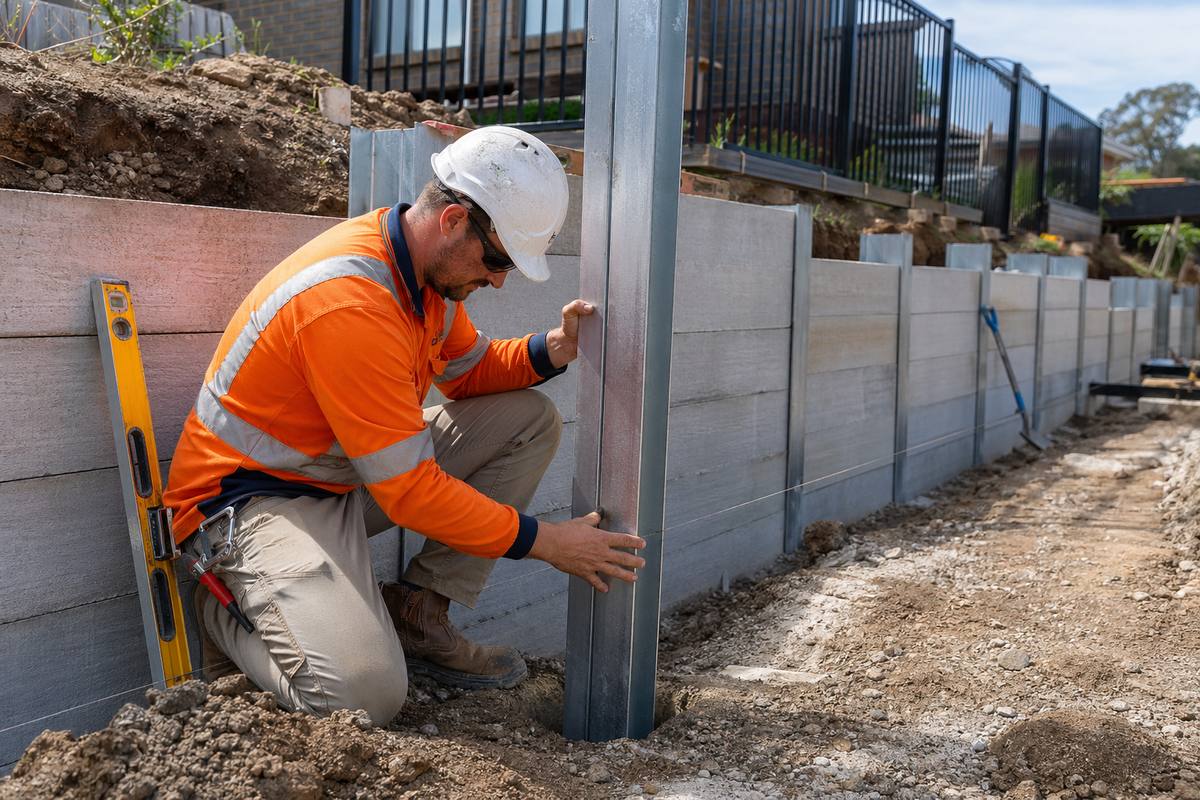
 Every retaining wall needs a strong backbone, and steel retaining wall posts are what provide it. The posts are the structural elements that resist the lateral pressure of retained soil, transferring loads safely into the ground through concrete footings. Choosing the right type and size of steel post is essential for a wall that performs as intended and meets Australian structural standards. This guide covers the main types of steel posts, how to size them correctly and what to consider during installation.
UC vs UB Steel Sections Explained
The two most common structural steel profiles used as steel retaining wall posts are Universal Columns (UC) and Universal Beams (UB). Understanding the difference helps you choose the right post for your project:
Universal Columns (UC) have a nearly square cross-section where the flange width is close to the overall depth. This gives them good resistance to bending in both directions. UC sections are the most popular choice for retaining wall posts because sleepers slide neatly between the wide flanges and the section performs well under the lateral soil pressures common in retaining wall applications.
Universal Beams (UB) are deeper and narrower than UC sections. They have higher bending capacity along their major (strong) axis but less resistance across the minor axis. UB posts are used where the wall height is significant and the engineer requires maximum bending strength in the direction of soil loading. Popular UB sizes for retaining walls include the 200UB18 and 250UB25.
Sizing Steel Posts for Wall Height
The correct post size depends primarily on the retained height of the wall, the soil type and any surcharge loading above the wall (such as driveways, fences or buildings). Here is a general sizing guide:
Up to 600 mm retained height — 100UC14.8 posts at 1800–2400 mm centres. Suitable for garden bed walls and low terraces.
600–1000 mm retained height — 150UC23.4 posts at 1500–2100 mm centres. The standard choice for most residential sleeper retaining walls.
1000–1200 mm retained height — 200UC46.2 or 200UB18 posts at 1200–1800 mm centres. Required where soil loads are higher or where the wall supports additional weight.
Over 1200 mm retained height — 250UC72.9 or 250UB25 posts with engineering-specified spacing. These walls almost always require a building permit and certified structural design.
These are indicative sizes only. A qualified structural engineer should design any retaining wall over 1000 mm in retained height or any wall supporting surcharge loads. RW Steel Victoria can supply posts to your engineer’s exact specifications.
Post Length and Embedment Depth
The total length of each steel post must account for three zones: the retained height above ground, any clearance above the top sleeper, and the embedment depth below ground. A common rule of thumb is that the below-ground portion should be at least equal to one-third of the total post length, with a minimum of 600 mm. For example, a wall retaining 1000 mm of soil with 100 mm clearance above the top sleeper and 900 mm embedment would require a post length of approximately 2000 mm.
Galvanised vs Raw Steel Posts
Steel posts for retaining walls are available in both galvanised and raw (uncoated) finishes. Galvanised posts are coated with zinc through a hot-dip process, providing exceptional protection against rust and corrosion. In soil contact, raw steel will begin to corrode within a few years, while galvanised posts can last 50 years or more. The additional cost of galvanising (typically 20–35% more than raw steel) is almost always justified for retaining wall applications where the posts are permanently buried.
Installation Best Practices
Proper installation of steel retaining wall posts is as important as selecting the right size. Follow these best practices:
Augered holes — Use a post hole auger to drill holes to the required depth. The hole diameter should be at least 100 mm larger than the post flange width to allow room for concrete.
Concrete footings — Fill holes with N20-grade concrete, ensuring the post is centred and plumb. Brace each post until the concrete has fully cured (at least 24 hours, preferably 48).
Alignment — Use a string line along the face of the posts to ensure the wall line is straight. Misaligned posts make sleeper installation difficult and result in an uneven wall face.
Drainage — Install ag pipe and gravel drainage behind the wall to prevent water pressure building up against the sleepers. This is particularly important in Melbourne’s clay soils.
Working with Concrete and Timber Sleepers
Steel posts are designed to work with both concrete and timber sleepers. The sleepers slide vertically between the post flanges, stacking from the bottom up. Ensure the sleeper thickness is compatible with the flange gap of your chosen post size. For concrete sleepers, a small amount of packing may be needed to take up any slack. For timber sleepers, ensure they are treated to H4 or H5 rating for in-ground and high-moisture contact.
Order Steel Posts for Your Retaining Wall
RW Steel Victoria is your specialist supplier for steel retaining wall posts across Melbourne, Gippsland and regional Victoria. We stock UC and UB sections in all standard sizes, available in galvanised or raw finish and cut to your required length. Request a quote online, view our project gallery for completed wall examples, or contact us for advice on post sizing and specifications.