When retaining walls need to hold back serious earth pressure — heights over 1.2 metres, heavy surcharge loads, or challenging soil conditions — structural engineers reach for the 250UC. As the heaviest commonly used Universal Column section in retaining wall construction, the 250UC provides the bending strength and rigidity needed for walls that lighter sections simply cannot handle. Here’s your complete guide to 250UC steel posts for retaining walls.
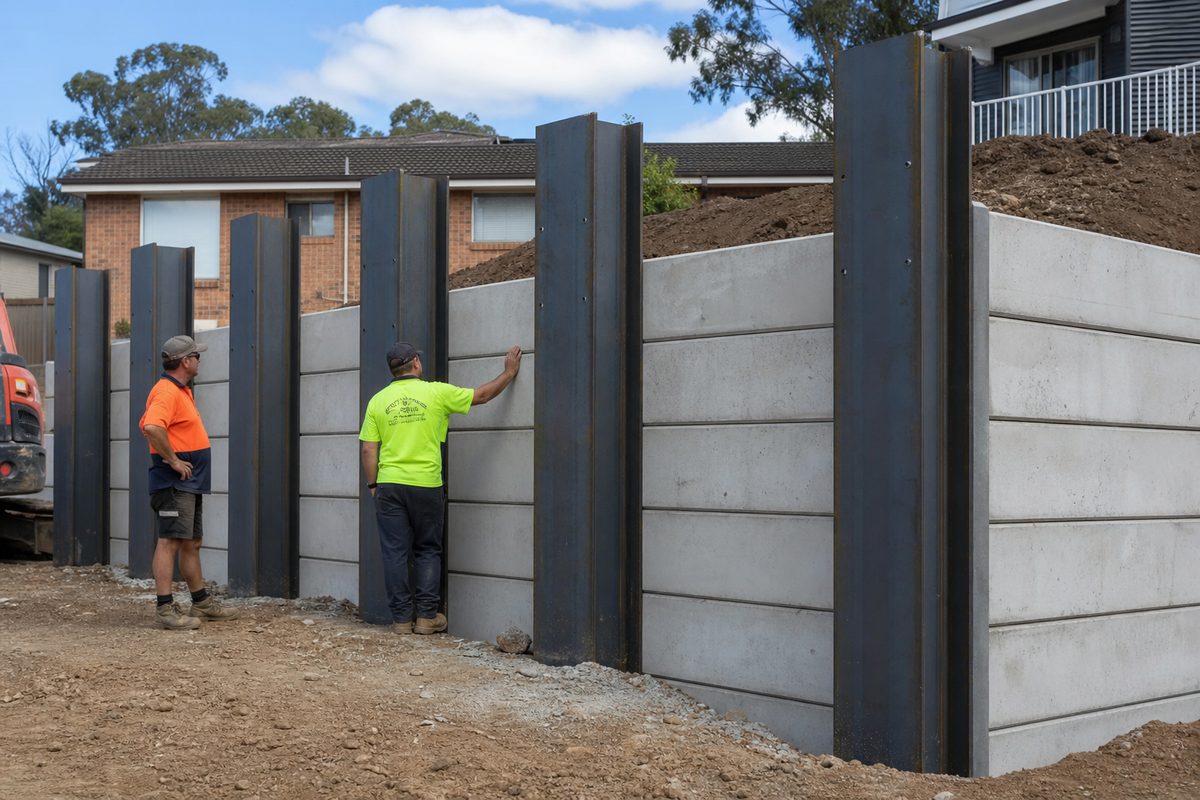
250UC Specifications and Dimensions
The 250UC family includes several weight grades, with the 250UC72.9 and 250UC89.5 being the most commonly specified for retaining wall applications:
250UC72.9: 254mm depth × 254mm flange width × 8.6mm web × 14.2mm flanges. Weight: 72.9 kg/m. Section modulus (Zx): approximately 895 cm³.
250UC89.5: 260mm depth × 256mm flange width × 10.5mm web × 17.3mm flanges. Weight: 89.5 kg/m. Section modulus (Zx): approximately 1,100 cm³.
To put that in perspective, the 250UC72.9 has roughly five times the bending capacity of a 150UC23.4. That enormous structural reserve is what makes the 250UC the specification of choice for high-consequence retaining walls.
When Engineers Specify 250UC Posts
The 250UC is not an everyday retaining wall post — it’s a heavy-duty solution for demanding applications. Structural engineers typically specify 250UC sections in the following scenarios:
Walls over 1.2m retained height: Any retaining wall over this threshold requires engineering certification in most Australian states. For retained heights of 1.5m to 2.0m, the 250UC is often the most practical single-span post solution.
Surcharge loads: Driveways, parking areas, or structures near the top of the wall create additional horizontal pressure. The 250UC’s high section modulus accommodates these loads with appropriate safety factors.
Poor soil conditions: Reactive clay, waterlogged ground, or fill material all increase earth pressure beyond standard assumptions. Engineers use 250UC posts to account for these higher-than-normal loads.
Tiered or stepped walls: Where multiple retaining walls are built in tiers, the lower wall often carries additional load from the wall above. 250UC posts in the lower tier ensure adequate capacity for the combined loading.
250UC vs 200UC: Making the Right Choice
Both the 250UC and 200UC are used for taller retaining walls, and the choice between them depends on the specific engineering requirements. The 200UC46.2 has a section modulus of approximately 451 cm³ — roughly half that of the 250UC72.9.
In practical terms, the 200UC is often sufficient for walls between 1.0m and 1.5m retained height in normal soil conditions. The 250UC takes over where the 200UC reaches its limits — walls approaching 2.0m, high surcharge scenarios, or where the engineer wants additional safety margin.
Cost and handling are also considerations. A 250UC72.9 post at 3m long weighs approximately 219 kg — well beyond what can be handled manually. Crane or excavator placement is essential. The 200UC at 3m weighs roughly 139 kg, which is also crane territory but somewhat more manageable. Your engineer’s specification should be the deciding factor, not cost alone.
Installation Requirements for 250UC Posts
Installing 250UC retaining wall posts is a professional job that requires proper planning and equipment:
Post holes: Holes must be large enough to accommodate the 254mm-wide section plus concrete cover — typically 600–700mm diameter. Bored piers (drilled by a piling rig) are often used for deeper or larger-diameter footings.
Buried depth: For a 1.5m retained height, expect a total post length of around 3.0m to 3.5m, with 1.2m to 1.5m buried in concrete. The exact embedment depth will be specified by the structural engineer based on soil bearing capacity and overturning resistance calculations.
Concrete: Footings for 250UC posts typically use N25 or N32 concrete, often with reinforcement cages around the post base. Allow 0.15–0.25 m³ per pier depending on diameter and depth.
Handling: At 73–90 kg per metre, 250UC posts require mechanical lifting for safe placement. An excavator with a lifting chain or a small crane is the standard approach on residential sites.
Drainage: For tall walls using 250UC posts, drainage design is critical. A combination of agricultural drain at the base, gravel backfill behind the wall, and geotextile fabric is standard practice. Inadequate drainage is the leading cause of retaining wall failure, regardless of how strong the posts are.
Galvanised or Raw: Finish Options for 250UC
250UC sections are available in both raw (uncoated) steel and hot-dip galvanised finish. For retaining wall use where the posts are buried in soil, galvanising is strongly recommended. The galvanised coating protects against corrosion in the most vulnerable zone — below ground level.
Galvanising a 250UC section is more expensive per metre than lighter sections due to the greater surface area and zinc consumption. However, the cost of galvanising is minor compared to the total project cost and the expense of replacing corroded posts down the track.
Get 250UC Posts From RW Steel Victoria
We supply 250UC sections in both 72.9 and 89.5 grades, available in raw or galvanised finish, cut to your specified lengths. With stock at our Victorian facility, we offer fast turnaround and delivery across Melbourne, Gippsland, and regional Victoria.
See completed projects in our gallery or browse our full range of retaining wall steel products. Need help with sizing? Request a quote or contact us for expert advice.