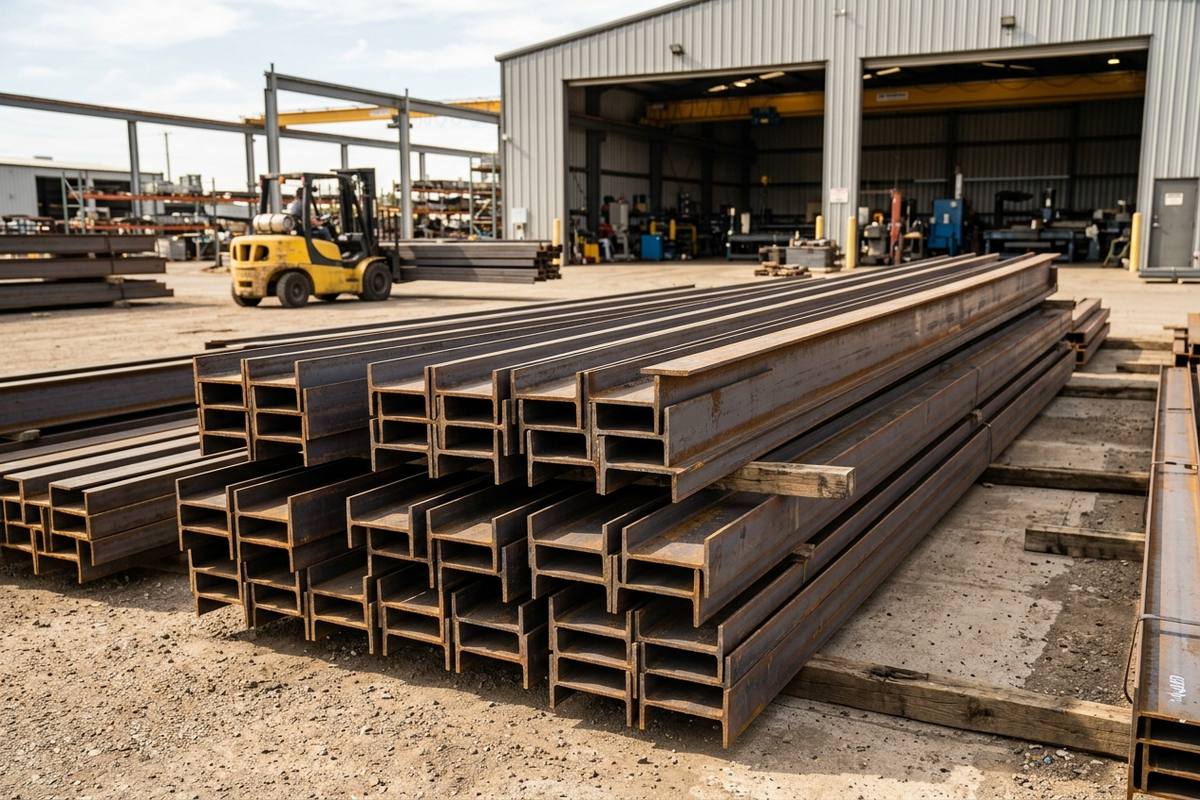
 When Melbourne builders and landscapers need a steel beam that balances strength with economy for medium to large retaining wall projects, the 250UB25 is often the first section they reach for. Versatile, widely stocked and well-suited to a broad range of structural applications, the 250UB25 is a cornerstone of the Australian structural steel market. In this guide we break down exactly what the designation means, key dimensions, load-carrying capacity and the practical scenarios where this section excels — including why it remains a firm favourite for retaining wall steel range projects across Victoria.
Whether you are a landscape contractor building a tiered garden in Brighton, a civil engineer speccing a property boundary wall in Werribee, or a builder sourcing lintels for a residential extension, understanding the 250UB25 will help you specify the right section with confidence.
This guide covers the beam’s technical specification, compares it against neighbouring sections and outlines best practices for installation in retaining wall applications.
What Does 250UB25 Mean?
The designation 250UB25 follows the standard Australian structural steel naming convention. Breaking it down:
- 250 — Nominal depth of 250 mm (the actual measured depth is approximately 248 mm).
- UB — Universal Beam. This is an I-section (also referred to as an H-beam) with flanges of relatively uniform width and a slender web, optimised for bending about the major axis.
- 25 — Mass per metre of 25.7 kg/m.
Together these three elements give engineers and builders an immediate read of the section: a mid-depth beam at just over 25 kg per linear metre. That combination of moderate weight and good depth makes it ideal for situations where you need meaningful bending resistance without incurring the additional cost and weight of a larger section.
Key Dimensions and Structural Properties
Based on the OneSteel / InfraBuild hot-rolled steel section tables (AS/NZS 3679.1), the 250UB25 has the following key dimensions:
- Depth (d): 248 mm
- Flange width (bf): 146 mm
- Web thickness (tw): 5.0 mm
- Flange thickness (tf): 8.0 mm
- Root radius (r1): 11 mm
- Mass: 25.7 kg/m
- Section moment of inertia (Ix): 35.4 × 10⁶ mm⁴
- Section modulus (Zx): 285 × 10³ mm³
- Plastic section modulus (Sx): 310 × 10³ mm³
The combination of a 248 mm depth and a relatively modest web thickness of 5 mm means this section achieves efficient bending performance for its weight. For retaining wall posts, the plastic moment capacity is a key design parameter — the 250UB25 develops a plastic moment of approximately 74 kNm in Grade 350 steel, making it well-suited for walls where lateral earth pressures and surcharge loads are significant.
Advantages of 250UB25 for Retaining Walls
The 250UB25 punches well above its weight in retaining wall applications. Here is why builders and landscapers across Melbourne prefer it for medium to large walls:
- Depth-to-weight ratio: At just under 26 kg/m you get a 248 mm deep section — that depth is what resists bending from earth pressure, and the 250UB25 delivers it economically.
- Broad flange: The 146 mm flange provides good lateral stability during handling and installation, reducing the risk of lateral torsional buckling before the post is fixed in the footing.
- Widely available: The 250UB25 is one of the most commonly stocked universal beams in Australia. RW Steel Victoria carries it in standard lengths suitable for wall posts, allowing fast turnaround on orders.
- Compatible with concrete sleepers and timber sleepers: The flange width accepts standard sleeper infill comfortably, and the web provides the structural spine that transfers lateral load to the footing.
- Grade 350 standard: Supplied as-rolled in Grade 350 steel (yield strength 360 MPa for this thickness range), providing superior strength over the older Grade 300 sections it replaces.
For further detail on how post sizing affects wall performance, see our steel post spacing guide and our comprehensive article on choosing the right steel beam size for your project.
How Does 250UB25 Compare to 200UB18 and 310UB?
Selecting the right section often means weighing up one step lighter or one step heavier. Here is a concise comparison:
200UB18 — When to Step Down
The 200UB18 (203 mm deep, 18.2 kg/m) is the natural choice when wall heights are modest — typically up to around 1.0–1.2 m retained height with standard residential surcharge. It weighs nearly 30% less than the 250UB25, which reduces both material cost and footing size. If your design calculations confirm that the bending demand does not require the extra depth of the 250 series, the 200UB18 is an economical downgrade. However, once walls push past 1.2 m retained height or carry vehicle surcharge, the 200UB18’s lower plastic moment capacity (around 42–45 kNm in Grade 350) often becomes the limiting factor.
310UB — When to Step Up
The 310UB series (lightest is the 310UB32 at approximately 311 mm deep, 32.0 kg/m) is appropriate when retained heights exceed approximately 1.8–2.0 m, post spacings are wide, or significant surcharge loads are present. The extra 60 mm of depth over the 250UB25 translates to a meaningfully larger moment of inertia and plastic moment capacity — roughly 50–60% more bending resistance. The trade-off is additional weight, cost, and the need for larger concrete footings. For most suburban retaining wall projects in Melbourne and regional Victoria, the 250UB25 hits the sweet spot before the step up to 310UB is warranted.
Common Applications Beyond Retaining Walls
While the 250UB25 is particularly popular as a retaining wall post, it performs across a range of structural applications:
- Structural frames: Portal frames, floor beams, and roof purlins in light industrial and residential construction.
- Lintels: Spanning openings in masonry construction where a deeper, stronger lintel is required compared to a 200UB section.
- Bridge stringers and sub-structures: Smaller bridge decks and footbridges in rural and regional settings.
- Mezzanine floors: Secondary beams in mezzanine floor construction where depth is less constrained than primary beams.
Installation Best Practices for Retaining Wall Posts
Correct installation is just as important as correct section selection. Follow these guidelines when using 250UB25 posts in a retaining wall:
- Embedment depth: As a general starting point, embed the post to a depth of at least 40–50% of the retained height, with a minimum of 600 mm into competent ground. For walls over 1.5 m retained, a geotechnical assessment and engineer sign-off is strongly recommended.
- Concrete footing: A concrete footing (Class N32 minimum) cast around the embedded length distributes load to the surrounding soil and prevents buckling of the embedded section. Ensure the concrete is at least 200 mm larger than the section width on each side.
- Post spacing: Typical post spacings for 250UB25 in residential landscaping retaining walls are 1.8–2.4 m for walls up to 1.5 m retained height, depending on soil type and surcharge. Tighter spacing may be required in expansive clay soils.
- Corrosion protection: For walls in exposed or high-moisture environments, use galvanised or Zincalume-treated sections. Our designing strong retaining walls guide covers protection options in detail.
- Plumb and alignment: Set posts to plumb before concrete sets. Use temporary bracing until concrete achieves initial cure (minimum 24 hours before back-filling).
Why Melbourne Builders and Landscapers Love the 250UB25
Melbourne’s diverse soil profile — from the stiff basalt clays of the inner suburbs to the sand and silt profiles of the Mornington Peninsula and the weathered rock profiles of the Dandenong Ranges — demands a post that can handle variable conditions without requiring a constant upsize. The 250UB25 provides a reliable, well-documented design solution that spans the majority of suburban retaining wall scenarios without the cost premium of a 310UB section.
Contractors also appreciate that the 250UB25 is almost always in stock, meaning lead times are short and projects can proceed without delays. You can browse our project gallery to see how this section has been used in completed retaining wall projects across Melbourne and Victoria.
If you are planning a retaining wall project and want guidance on whether the 250UB25 is the right section for your specific conditions, contact our team or request a quote and we will help you specify the right steel for the job. We deliver across Melbourne and all of Victoria, with fast turnaround on standard section lengths.