“What steel do I need for my retaining wall?” is the question we answer most often. The honest reply is that retaining wall steel is a system, not a single product: the section decides stiffness, the grade decides strength, the finish decides how long it lasts, and the spacing and footing decide whether any of it matters. Here is how the four choices fit together.
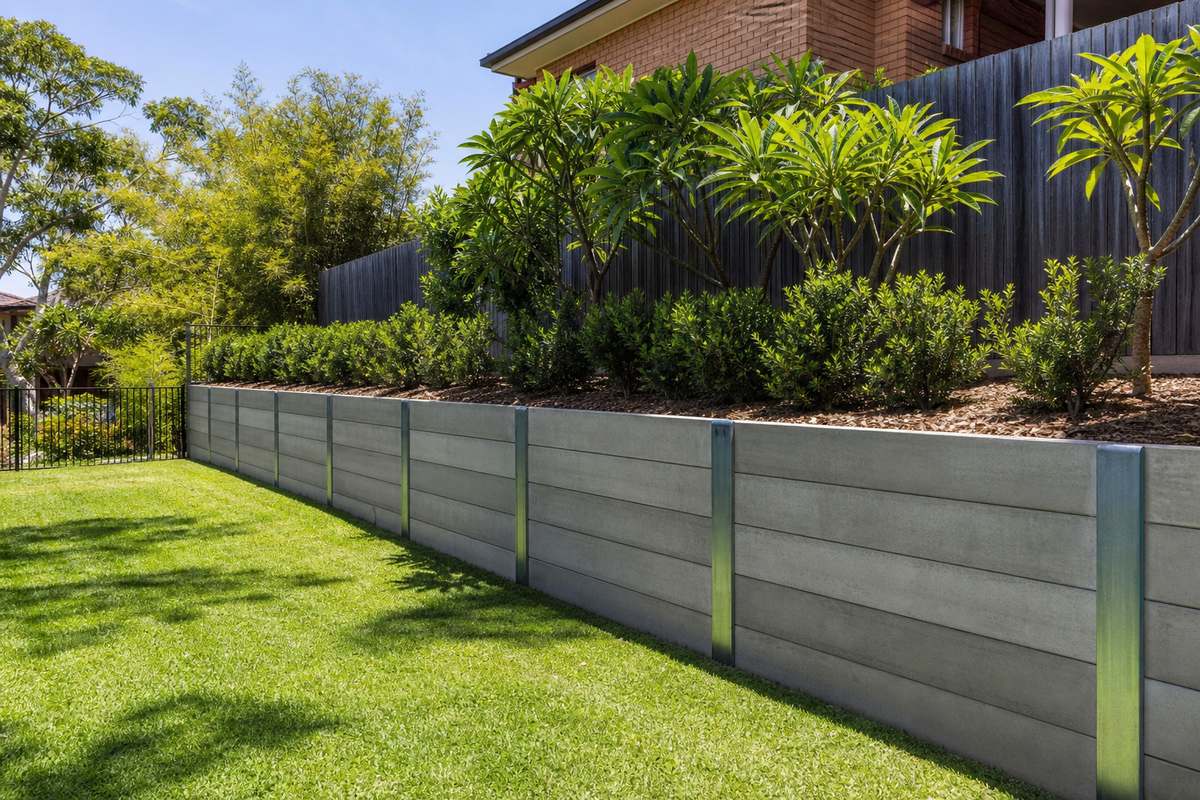
1. Section: UC, UB or PFC
Universal columns (UC) have wide flanges and roughly square proportions, which makes them the natural choice for retaining wall posts — the sleeper slides between the flanges and the post resists bending in the direction the soil pushes. Universal beams (UB) are deeper and narrower; they give you more bending capacity per kilogram but the narrower flange suits thinner sleepers. Parallel flange channels (PFC) show up at wall ends and where a flat back face is needed.
Our comparison of UC and UB sections for retaining wall posts works through the trade-off with real sizes. As a rough guide: 100UC15 for garden walls, 150UC30 for most 1.0–1.5 m residential walls, 200UC or 250UC once you are above that or carrying a surcharge.
2. Grade: why 300PLUS is the standard
Almost all Australian hot-rolled structural sections are supplied to AS/NZS 3679.1 grade 300 (300PLUS), meaning a minimum yield of about 300 MPa. That is what engineers assume in their calculations, so mixing in an unknown imported section with a lower yield quietly removes your safety margin. Ask for mill certification if the wall is engineer-designed — we can supply it.
3. Finish: galvanised, black or weathering steel
- Hot-dip galvanised — the default for buried posts. See our guide to galvanised steel retaining wall posts.
- Black steel — cheapest, acceptable only where fully encased or genuinely temporary.
- Corten / weathering steel — for exposed architectural walls where the patina is the design; see Corten retaining walls.
4. Spacing, embedment and footings
Post centres are usually set by the sleeper length — commonly 1.2 m, sometimes 1.5 m or 2.0 m. Halving the spacing roughly halves the load on each post, so tight spacing with a smaller section can be cheaper and easier to handle than heavy posts at wide centres. Embedment is typically in the order of two-thirds of the retained height into a concrete footing, but that is a rule of thumb, not a design: soil class, surcharge and slope all move it.
Drainage sits alongside the steel. An agricultural drain behind the wall with free-draining backfill removes the hydrostatic pressure that most failed walls actually died from — no section size compensates for a wall holding back water.
What to have ready when you call
- Retained height (bottom of wall to finished surface above)
- Total wall length and any steps or corners
- Sleeper type and thickness — concrete, timber or steel
- Anything sitting behind the wall: driveway, pool, shed, slope
- Access for delivery and whether you want posts pre-drilled
Talk it through before you order
We cut, drill and galvanise to order, and we supply matching sleepers and accessories so the wall arrives as one package. Send the numbers above through the quote form or the contact page and we will tell you what we would use — including when a smaller section at closer centres will save you money.