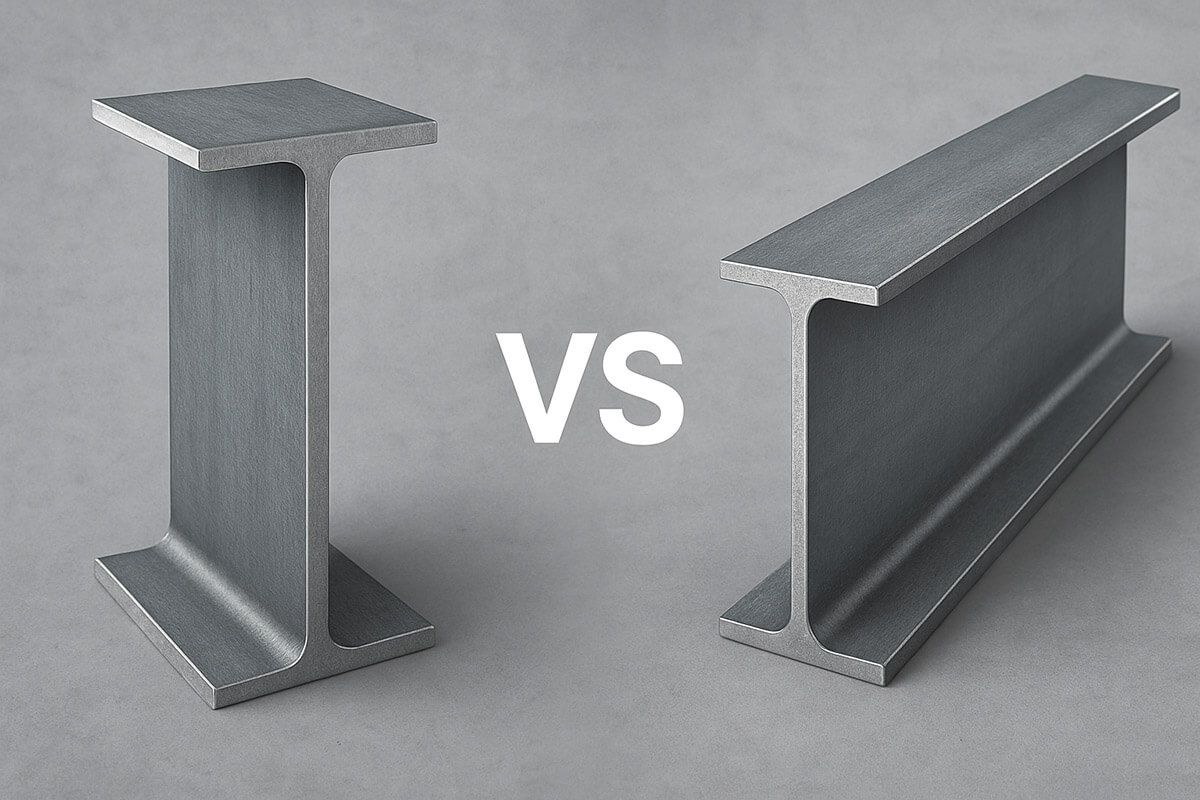
 When it comes to building a retaining wall that lasts, the choice of steel section plays a major role in ensuring long-term strength and structural stability. In Australia, builders and landscapers often choose between Universal Columns (UC) and Universal Beams (UB) when designing steel retaining wall systems. Among the most common options are 100UC15 and 200UB18, both highly reliable but designed for different applications.
This guide will help you understand the key differences between these steel profiles, how to match them to your wall’s design, and what to consider before making your final decision.
Understanding UC and UB Steel Sections
Both UC and UB beams belong to the family of hot-rolled structural steel shapes that are essential in Australian construction.
- Universal Columns (UC) feature a near-square cross-section, meaning their flanges (the horizontal parts of the beam) are nearly the same width as the web (the vertical part). This makes them ideal for vertical load-bearing applications, such as steel posts for retaining walls.
- Universal Beams (UB) have wider flanges relative to their depth. This shape provides excellent horizontal bending strength, which is why UBs are often used for spans, framing, and load distribution across a wider area.
In short:
- UC = best for vertical loads (posts)
- UB = best for horizontal loads (beams or cross supports)
Comparing 100UC15 and 200UB18
Let’s break down these two steel profiles to see how they perform in retaining wall applications.
100UC15: The Lightweight Column
The 100UC15 section is a popular choice for smaller retaining walls and garden projects. It’s compact, affordable, and easy to handle, yet still strong enough to provide the structural support needed for most low-height walls.
- Dimensions: approximately 100 mm deep, weighing 15 kg per metre.
- Best used for: retaining walls under one metre high, raised garden beds, or decorative landscape edges.
- Advantages: lightweight, easy to cut and install, and ideal for DIY projects.
Because of its smaller size, 100UC15 performs best in stable soil with good drainage and limited load pressure from retained earth. If you’re building in sandier soil or where rainfall isn’t excessive, this section is more than sufficient.
200UB18: The Mid-Strength Beam
The 200UB18, on the other hand, is designed for medium-duty applications where the wall must hold back greater loads. Its wider flanges give it more resistance to bending, making it suitable for both upright posts and horizontal framing components.
- Dimensions: approximately 200 mm deep, weighing 18 kg per metre.
- Best used for: retaining walls between 1.2 and 1.8 metres high or where soil pressure is moderate to high.
- Advantages: greater bending resistance, stronger load-bearing capacity, and ideal for engineered or sloped-site retaining walls.
For homeowners or contractors in Melbourne’s clay or loam-heavy areas — where soil expands and contracts — the 200UB18 offers superior stability and durability.
Matching the Right Beam to Your Project
When choosing between 100UC15 and 200UB18, consider three key factors:
- Wall Height
- Walls under 1 metre generally perform well with 100UC15.
- For anything taller, a 200UB18 or larger UC section is recommended.
- Always remember that taller walls increase the lateral load on the posts exponentially, not linearly.
- Soil Type
- Clay and reactive soils exert more pressure and retain water, which increases the force against the wall.
- Sandy soils drain better and put less stress on the wall.
- If in doubt, choose the stronger profile — especially for Melbourne’s variable ground conditions.
- Drainage and Backfill
- Even the best steel won’t perform well without proper drainage.
- Add perforated Agi pipes, scoria backfill, and geofabric to relieve hydrostatic pressure.
- This reduces corrosion risk and prolongs the life of your retaining wall steel.
Why Galvanisation Is Non-Negotiable
Both UC and UB sections should be hot-dip galvanised before installation. The zinc coating protects the steel from rust and corrosion, which is crucial when the posts are embedded in soil and exposed to moisture.
Galvanised steel not only extends the life of the retaining wall but also reduces maintenance costs over time. In coastal areas around Melbourne or the Mornington Peninsula, galvanisation is especially important due to salt exposure.
For maximum durability, always check that your steel retaining wall posts are certified to Australian Standards (AS/NZS 3679.1) and supplied by a reputable local manufacturer.
Engineering and Installation Considerations
Proper installation is just as important as material selection. Here are a few quick pointers:
- Posts should be set in concrete footings that are at least one-third of the wall’s height deep.
- Use high-strength concrete (25 MPa or above) to ensure the post remains stable over time.
- Keep posts perfectly plumb and spaced evenly to prevent leaning or misalignment once sleepers are installed.
- If your retaining wall exceeds one metre, you’ll need engineering certification and may require council approval.
Even if you’re building a smaller wall, consulting an engineer or steel supplier can save time and prevent structural problems later on.
Conclusion
Choosing between 100UC15 and 200UB18 depends on your project’s height, soil conditions, and expected load. For smaller, decorative walls or light landscaping, 100UC15 offers a cost-effective and practical solution. For taller, load-bearing, or engineered retaining walls, 200UB18 provides the strength and rigidity needed to stand the test of time.
By pairing the right beam with proper galvanisation, footings, and drainage, your retaining wall steel will deliver exceptional performance for decades. It’s a small decision that makes a big difference in ensuring your wall remains safe, compliant, and built to last.