If you’re planning a retaining wall project, you’ve likely come across the term steel H beams — but what exactly are they, and how do you choose the right one? The H beam (or H section) is the workhorse of retaining wall construction, providing the vertical structural support that holds sleepers in place and resists earth pressure. This guide breaks down the different types of steel H beams available for retaining walls, their sizes, and how to select the right profile for your specific project.
What Are Steel H Beams?
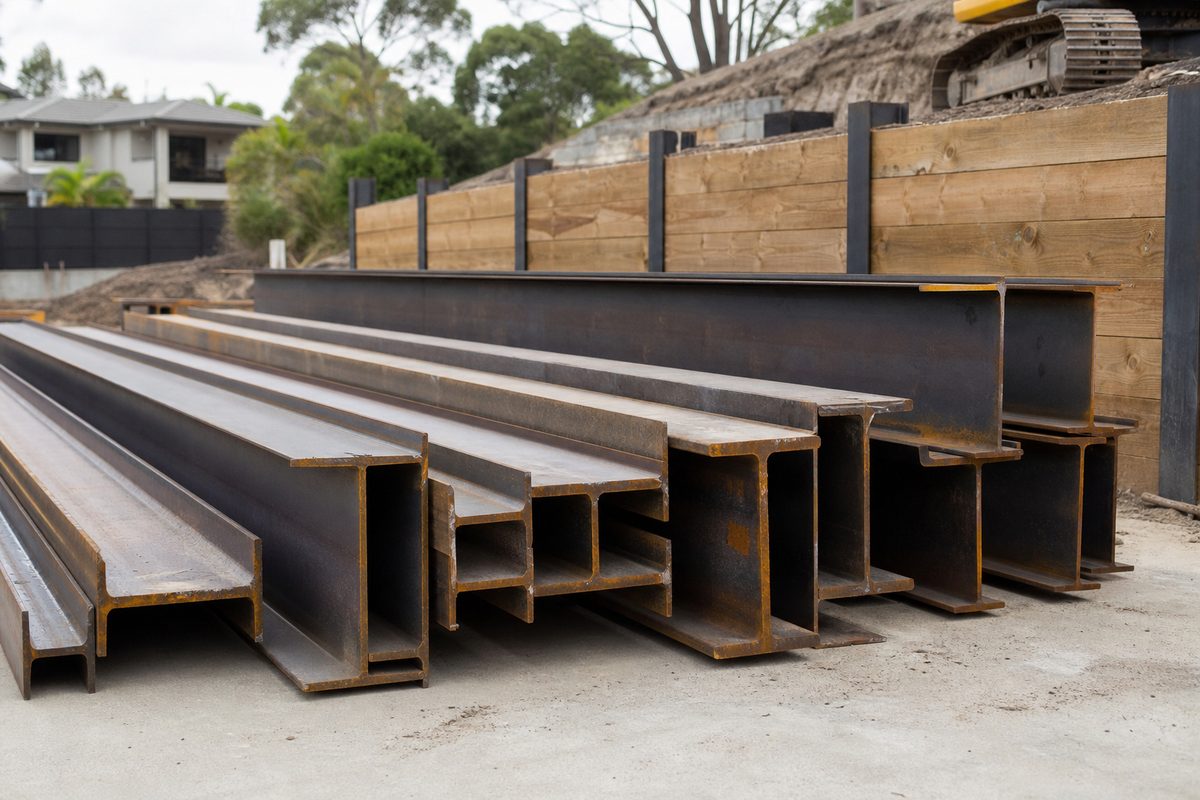
Steel H beams get their name from their cross-sectional shape — when viewed end-on, the profile looks like the letter H. The horizontal parts are called flanges and the vertical part connecting them is the web. In retaining wall applications, the flanges create channels on each side of the post where sleepers slot in, while the web provides the bending strength to resist horizontal earth pressure.
The term “H beam” is used loosely in the retaining wall industry and can refer to several different structural steel profile types. Understanding the differences is important because each type has distinct properties, strengths, and best-use cases.
Types of Steel H Beams for Retaining Walls
There are three main types of steel H beam profiles used in Australian retaining wall construction:
1. Universal Columns (UC) — These are the true H sections, with flanges approximately equal in width to the section depth. Common sizes include 150UC, 200UC, and 250UC. Universal Columns have the highest bending strength for their weight and are specified by structural engineers for medium to tall retaining walls (800mm+ retained height).
2. Universal Beams (UB) — UB sections are deeper and narrower than UC sections. The flanges are significantly narrower than the section depth, giving a more rectangular profile. Common retaining wall sizes include 150UB, 200UB18, and 250UB25. UBs are sometimes used where depth is an advantage but flange width is less critical.
3. H-Channel Posts — Purpose-made galvanised H-channel posts are lighter sections specifically designed for sleeper retaining walls. They’re available in sizes from 50mm to 150mm depth and are the most affordable option for low walls. At RW Steel Victoria, these are our most popular product for residential DIY retaining walls up to 800mm.
UC vs UB: Which H Beam Is Better for Retaining Walls?
The UC vs UB debate is one of the most common questions in retaining wall construction. Here’s how they compare:
Bending strength: For the same nominal depth, UC sections generally have a higher section modulus about the major axis (the direction that resists earth pressure). A 150UC23.4 has a Zx of approximately 171 cm³, while a 150UB14 has a Zx of approximately 109 cm³.
Flange width: UC sections have wider flanges, which provides better lateral stability and a wider channel for sleepers. This makes them easier to work with when sliding sleepers into place.
Weight and cost: UB sections are lighter per metre for the same depth, making them cheaper and easier to handle. For budget-conscious projects where an engineer confirms the UB is adequate, they can be a cost-effective alternative.
The verdict: For retaining walls, UC sections are generally the preferred choice due to their superior bending strength and wider flanges. UB sections can work well in specific applications, but should only be used when specified or approved by a structural engineer.
Sizing Guide: Matching H Beams to Wall Height
As a general guide for steel H beam selection based on retained wall height (always confirm with an engineer for walls over 1m):
Under 600mm: Galvanised H-channel posts (75–100mm) or 100UC sections. These are DIY-friendly and don’t typically require engineering certification.
600mm – 1,000mm: 100UC to 150UC sections, or heavier H-channel posts. Post spacing of 1.5–2.0m. Engineering may be required depending on your local council.
1,000mm – 1,500mm: 150UC to 200UC sections. Engineering certification is mandatory. Closer post spacing (1.2–1.5m) and deeper concrete footings are standard.
Over 1,500mm: 250UC sections or engineered solutions with additional bracing. Professional installation is essential at these heights.
Galvanised vs Raw Steel H Beams
For any steel H beam that will be buried in the ground — which includes every retaining wall post — hot-dip galvanising is the recommended protective finish. The galvanised zinc coating sacrificially protects the steel from corrosion, extending the post life to 50 years or more in typical Victorian soils.
Raw (uncoated) steel H beams are available at lower cost and can be used where the wall is temporary, where posts are above ground, or where alternative corrosion protection (such as epoxy coating or cathodic protection) is specified. For permanent in-ground retaining wall posts, galvanised is always the better long-term investment.
Shop Steel H Beams at RW Steel Victoria
RW Steel Victoria carries a comprehensive range of steel H beams for retaining walls — from lightweight galvanised H-channel posts for garden walls to heavy 250UC sections for engineered retaining structures. We cut to length, offer galvanising on all sections, and deliver across Melbourne and regional Victoria.
Not sure which H beam is right for your project? Our team can help you match the right section to your wall height and soil conditions. View our project gallery for inspiration, get a quote, or contact us for expert advice.