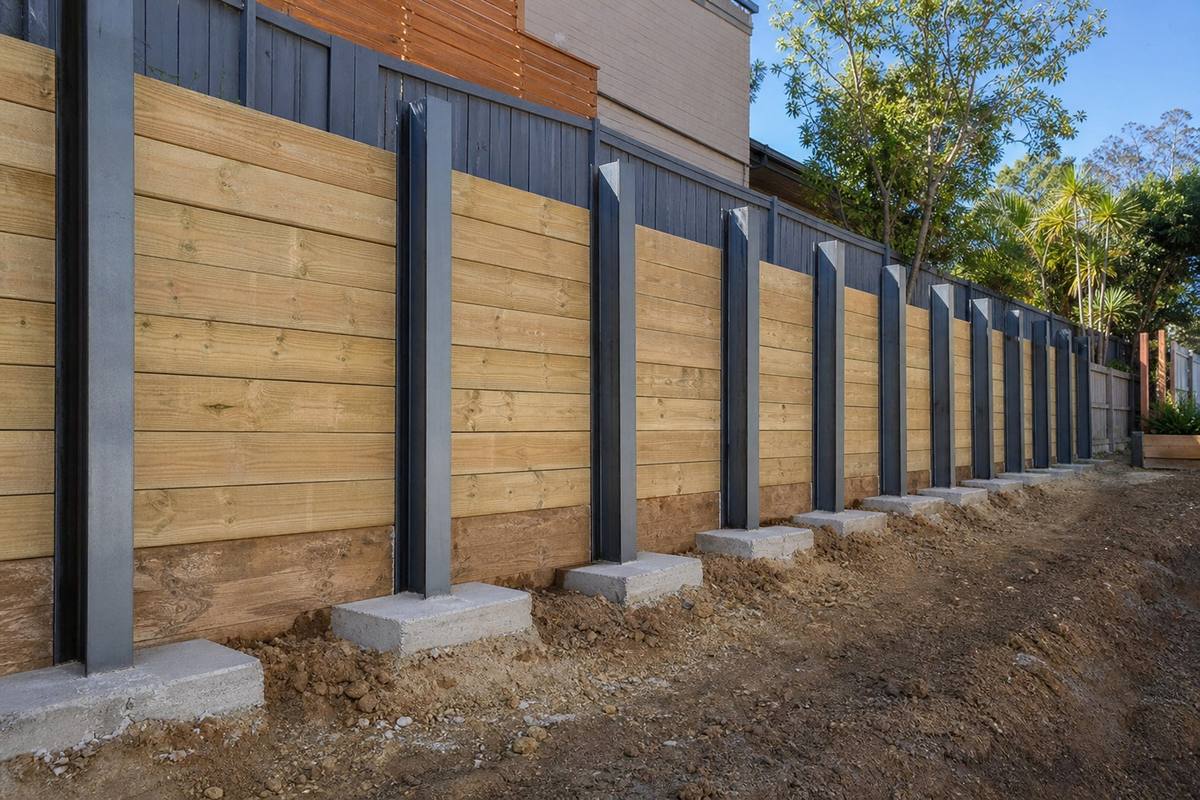
 Choosing the right steel posts for a retaining wall is one of the most important decisions in any landscaping or construction project. The steel post retaining wall specifications you select — including section size, embedment depth and load capacity — directly determine how long the wall will last and whether it meets Australian engineering standards. At RW Steel Victoria, we supply a full range of UC and UB steel sections sized specifically for retaining wall applications across Melbourne and regional Victoria.
Understanding Steel Post Section Types
Retaining wall steel posts are available in two main profile types: Universal Columns (UC) and Universal Beams (UB). UC sections have a near-square flange profile, making them naturally suited to resist bending forces from both directions. UB sections are deeper and narrower, providing higher moment capacity along their major axis. For most residential retaining wall steel projects, UC sections between 100UC and 250UC cover the majority of wall heights from 600 mm up to 1500 mm and beyond.
Common Steel Post Sizes and Dimensions
Here is a quick reference for the most popular retaining wall steel post sizes used across Victoria:
100UC14.8 — Flange width 99 mm, depth 97 mm. Suitable for walls up to approximately 600 mm in retained height with standard soil conditions. A cost-effective option for low garden beds and terraced landscapes.
150UC23.4 — Flange width 152 mm, depth 152 mm. Handles retained heights up to around 1000 mm. This is the most commonly specified size for residential sleeper retaining walls in Melbourne suburbs.
200UC46.2 — Flange width 203 mm, depth 203 mm. Designed for walls up to 1200 mm and higher where soil loads or surcharge pressures are significant. Often required by engineers for boundary walls or walls supporting driveways.
250UC72.9 — Flange width 254 mm, depth 254 mm. Used for heavy-duty retaining walls exceeding 1200 mm retained height, particularly on sloping blocks or where vehicle loading is present above the wall.
Embedment Depth Requirements
The depth that steel posts must be embedded below ground level is critical to the structural integrity of the wall. As a general rule, posts should be embedded at least one-third of the total post length below ground level, with a minimum of 600 mm. For a wall retaining 1000 mm of soil, a typical post length would be 2400 mm — 1000 mm above ground for the retained height, 400 mm clearance and 1000 mm below ground set in concrete. Your engineer’s specifications will provide the exact depth required for your soil type and wall height.
Concrete Footing Specifications
Steel posts are typically set into concrete footings with a minimum strength of 20 MPa (N20). Footing diameters range from 300 mm for 100UC posts up to 450 mm or more for 250UC sections. The concrete should extend from the base of the hole to within 50–100 mm of the finished ground level. Ensure the post is plumb and braced before the concrete sets — movement during curing can compromise the wall’s alignment and load capacity.
Post Spacing and Load Ratings
Standard post spacing for sleeper retaining walls is between 1200 mm and 2400 mm centres, depending on the wall height and the type of sleepers used. Concrete sleepers are heavier and transfer more load, often requiring closer post spacing or larger UC sections. Timber sleepers are lighter but may require more frequent post spacing to prevent bowing. For engineered designs, the structural engineer will calculate the bending moment, shear force and deflection limits for the selected steel post retaining wall specifications to determine exact spacing.
Australian Standards and Engineering Compliance
In Victoria, any retaining wall over 1000 mm in height (or lower if it supports a surcharge such as a driveway or building) requires a building permit and engineering design. The relevant standard is AS 4678 — Earth Retaining Structures. Steel sections must comply with AS/NZS 3679.1 for hot-rolled structural steel. All designs should be prepared or certified by a practising structural engineer. We recommend contacting your local council early to confirm permit requirements for your specific project.
Galvanised vs Uncoated Steel Posts
For retaining walls exposed to moisture and soil contact, galvanised steel posts offer significantly longer service life. Hot-dip galvanising applies a thick zinc coating that protects the steel from corrosion for decades. Uncoated (raw) steel posts will rust over time, particularly in the below-ground section where moisture is constant. If budget is a concern, consider galvanising at minimum the below-ground portion of each post.
Get the Right Specifications for Your Project
At RW Steel Victoria, we supply steel posts cut to length and can advise on the correct section size for your wall height and soil conditions. Whether you need a quote for galvanised UC posts or want to discuss specifications with our team, we are here to help. Browse our project gallery to see completed retaining walls using our steel, or contact us directly for expert advice.