When a retaining wall gets taller than about 1.2 metres, or the ground behind it carries a driveway, pool surround or building load, a light post simply will not do the job. The 200UC universal column is the size most Victorian engineers reach for at that point — strong enough for serious retained heights, yet still practical to handle, drill and galvanise. Here is what the 200UC actually offers and how it compares with the sizes either side of it.
What 200UC means
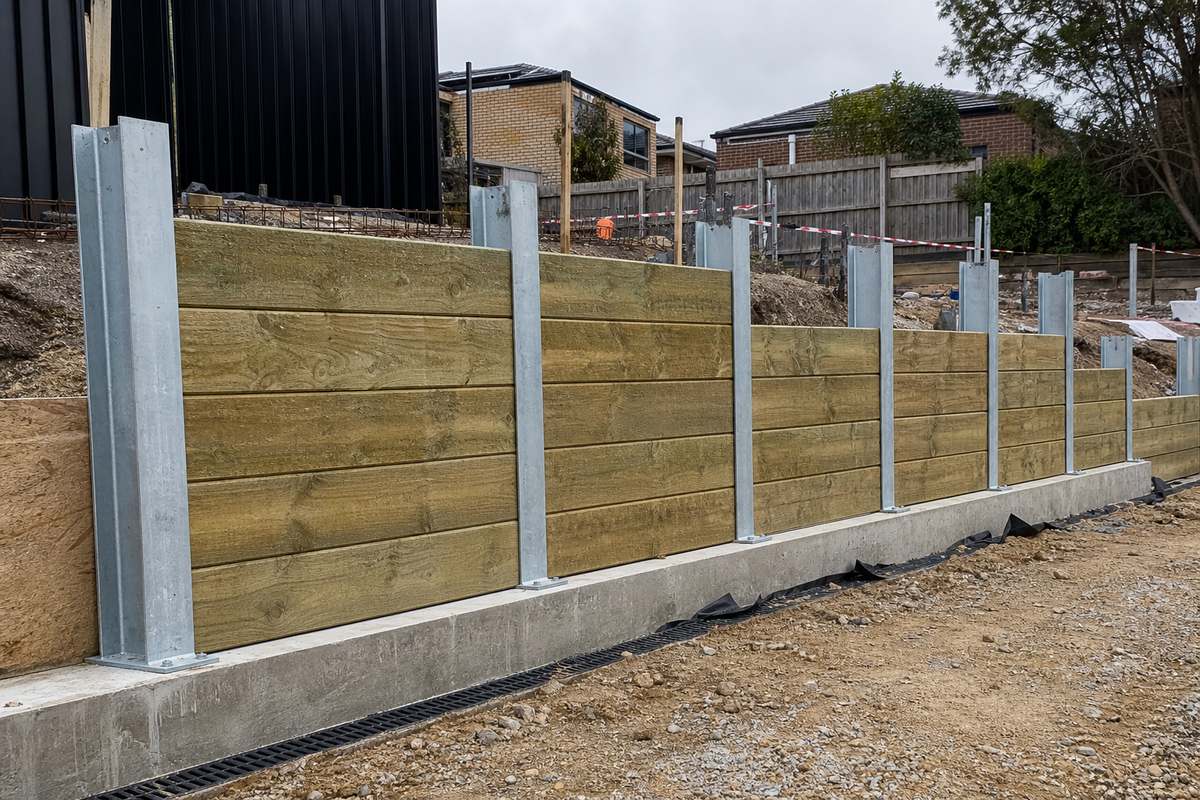
“UC” stands for universal column: a hot-rolled I-shaped section with wide, parallel flanges and a relatively thick web. The 200 refers to the nominal depth in millimetres. Because the flanges are wide, a UC resists bending in both directions and is far more stable under load than a beam of the same weight, which is exactly what you want in a post that is cantilevered out of the ground. The flange gap also forms the slot that concrete sleepers or timber sleepers drop into, which is why these are commonly called H-section retaining wall posts.
200UC sizes and weights
The 200UC family is supplied in several mass-per-metre options. The differences are in flange and web thickness rather than overall depth, so all of them accept the same sleeper thickness:
- 200UC46.2 — 203 mm deep, 203 mm flange width, 46.2 kg/m. The everyday choice for walls roughly 1.2–2.0 m.
- 200UC52.2 — 206 mm deep, 204 mm flange width, 52.2 kg/m. A step up where surcharge loads apply.
- 200UC59.5 — 210 mm deep, 205 mm flange width, 59.5 kg/m. Used for tall walls, sloping backfill or vehicle surcharge.
As a rough guide, a 200UC46.2 post weighs about 46 kg per metre, so a 3.0 m post (2 m exposed, 1 m footing) is around 140 kg before galvanising. That matters on site: 200UC and above generally needs two people or machine assistance to place, unlike the lighter 150UC sections.
When to specify 200UC instead of 150UC
The jump from 150UC to 200UC roughly doubles the section modulus, which means a much larger bending capacity for the same post spacing. Typical triggers for stepping up to 200UC include:
- Retained height above about 1.2–1.5 m with standard 1.5 m post centres
- A driveway, carport or parking area within the zone of influence behind the wall (vehicle surcharge)
- Sloping or terraced backfill that adds an equivalent extra height of soil
- Poor, reactive or saturated clay soils that reduce passive resistance in the footing
- Walls supporting a pool shell, shed slab or boundary structure
Every one of those cases should be signed off by a structural engineer. Post size, spacing, embedment depth and footing diameter are a package — increasing the post but keeping a shallow footing simply moves the failure point underground. Our guide to retaining wall specifications walks through how those numbers relate.
Footings and embedment for 200UC posts
A 200UC post is normally set in a concrete footing 450–600 mm in diameter, with embedment of one third to one half of the total post length depending on soil classification. Deeper is not automatically better: footing diameter drives the passive resistance just as much as depth. Keep the post plumb in two planes, brace it while the concrete cures, and check the sleeper slot alignment along the run with a string line before the concrete goes off.
Galvanising and durability
For any wall that will be buried in damp soil, hot-dip galvanising to AS/NZS 4680 is the minimum specification. A typical coating of 85–100 microns gives decades of service in normal Melbourne conditions. Avoid site-cutting galvanised posts where possible — order to length so the cut ends do not expose bare steel. If cutting is unavoidable, treat the cut with a zinc-rich cold galvanising paint. All posts supplied through our retaining wall steel range can be supplied hot-dip galvanised and cut to your engineer’s schedule.
Pairing 200UC with sleepers
200UC accepts standard 200 mm high concrete sleepers, and the wide flange gives good bearing for thicker premium sleepers. Check the sleeper range for thickness options, and remember that taller walls generally justify a thicker sleeper as well as a bigger post. Ag drain, geofabric and free-draining backfill behind the wall are non-negotiable at this height — hydrostatic pressure from a blocked drain is a far more common cause of failure than an undersized post.
Get 200UC posts cut and galvanised for your job
We supply 200UC46.2, 200UC52.2 and 200UC59.5 posts across Melbourne, Geelong and Gippsland, cut to length and hot-dip galvanised. Send through your engineer’s drawings or a simple sketch with heights and lengths and we will price it: use the quote and order form or contact our team to talk sizes. Recent projects are in the project gallery.