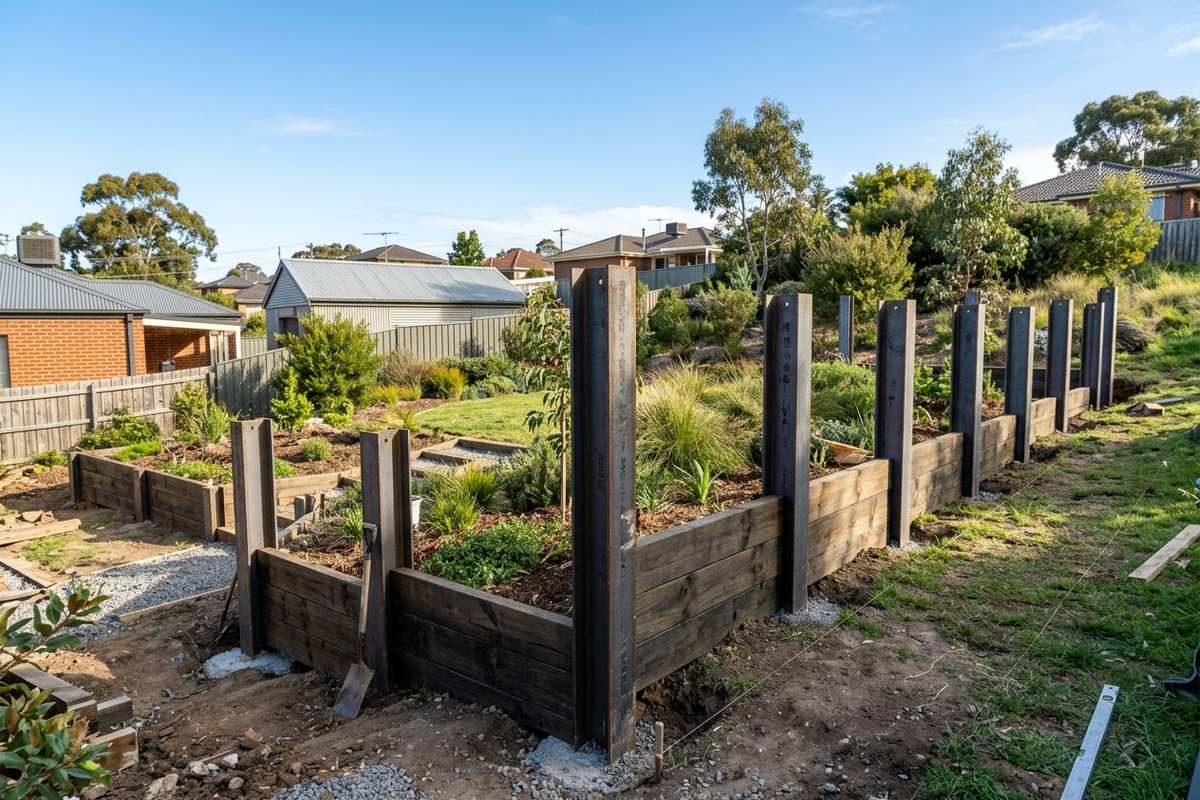
When it comes to building a sturdy, long-lasting retaining wall, the choice of steel post is everything. Steel retaining wall H beams — commonly known as UC (Universal Column) sections — are the go-to structural solution for residential and commercial retaining walls across Melbourne and Victoria. Their superior strength, predictable performance, and compatibility with timber sleepers and concrete panels make them a preferred choice for builders, landscapers, and DIYers alike.
Whether you’re managing a sloping backyard in the outer eastern suburbs, terracing a block in Melbourne’s hilly north, or constructing a commercial cut-and-fill wall in regional Victoria, understanding retaining wall steel H beams will help you design a wall that performs reliably for decades.
What Are Steel H Beams for Retaining Walls?
The term “H beam” refers to the characteristic H-shaped cross-section of Universal Column and Universal Beam steel sections. The two horizontal plates — called flanges — are connected by a vertical plate called the web, forming the recognisable H profile when viewed end-on.
In retaining wall applications, these sections are installed vertically into the ground as posts, with timber sleepers, concrete panels, or other infill materials slotted between them or bolted to the flanges. The H shape provides excellent resistance to the lateral (sideways) soil pressure that retaining walls must constantly withstand.
The two main section types used as steel retaining wall posts in Australia are:
- UC (Universal Column) — Designed primarily for vertical load-bearing, with wider flanges relative to depth. Ideal as retaining wall posts due to their stiffness in both axes.
- UB (Universal Beam) — Designed for bending loads, taller and narrower. Used in retaining walls where greater depth (and bending resistance) is needed for taller walls.
UC vs UB: Which Steel Section Is Right for Your Retaining Wall?
Choosing between UC and UB sections depends on your wall height, soil type, post spacing, and load requirements. For a practical sizing guide, see our article on choosing the right steel beam size for retaining walls in Melbourne. Both are widely used as steel retaining wall posts across Victoria, but they behave differently under load.
UC sections (such as 100UC15, 150UC23.4, and 200UC46.2) have nearly square cross-sections with thick flanges. This makes them exceptionally stiff and strong in both the horizontal and vertical directions — critical for resisting the overturning moment that soil pressure places on a retaining post. UC sections are the most commonly specified posts for residential retaining walls up to around 1.5–2 metres in height.
UB sections (such as 150UB14, 200UB18, and 250UB25) are taller and narrower, making them better suited for walls where greater depth is needed to increase bending capacity. For taller retaining structures — say 2 metres or more — a deeper UB section can deliver the required stiffness without the extra weight of a heavier UC.
In practice, both section types are used interchangeably on many Victorian sites, with the final selection driven by the engineer’s specification or the project requirements.
Steel Post Retaining Wall Specifications to Consider
Getting the steel post retaining wall specifications right is essential for a safe, code-compliant build. Key factors include:
Post Depth (Embedment)
For most residential retaining walls, the post embedment depth should be at least 40–50% of the exposed wall height. For example, a 1-metre-high wall typically requires posts to be embedded at least 400–500 mm into the ground. For taller walls or soft/reactive soils (common across Melbourne’s inner and outer suburbs), a structural engineer may specify deeper embedment — often 600–900 mm or more — along with concrete encasement at the base.
Post Spacing
Standard post spacing for sleeper retaining walls using steel H beams is typically 1.2 m to 2.4 m on centre, depending on sleeper thickness, wall height, and post size. Tighter spacing reduces the bending demand on each post and is commonly used for taller walls or when using lighter-gauge steel sections.
Section Weight and Size
Section weight (in kg per metre) directly reflects the amount of steel and hence the strength and stiffness of the section. Common sizes and their weights include:
- 100UC15 — 15.0 kg/m — suitable for low residential walls up to ~800 mm high
- 150UC23.4 — 23.4 kg/m — popular for walls up to ~1.2 m high with standard soil conditions
- 200UC46.2 — 46.2 kg/m — used for taller or more heavily loaded walls
- 200UB18 — 18.0 kg/m — a lightweight option for moderate wall heights
- 250UB25 — 25.7 kg/m — a versatile section for mid-height retaining walls
Corrosion Protection
In the ground and exposed to moisture, bare steel will corrode over time. For retaining wall posts in Victoria, galvanised steel sections are strongly recommended. Hot-dip galvanising provides a thick zinc coating that protects the steel from rust for 20–40 years or more in typical soil conditions. This is particularly important in Melbourne’s reactive clay soils, which retain moisture and can accelerate corrosion in unprotected steel.
Applications of Steel H Beam Retaining Walls in Melbourne and Victoria
Steel H beam retaining walls are used throughout Victoria in a wide range of settings:
- Residential backyards — Managing sloping blocks across Melbourne’s hills and outer suburbs, creating usable level terraces for lawns, gardens, or entertaining areas
- Driveways and road cuts — Stabilising banks alongside driveways, particularly on steep sites in areas like the Dandenong Ranges, Yarra Valley, and Mornington Peninsula
- Commercial and civil projects — Car park retaining walls, loading dock edges, and cut-and-fill situations across metropolitan and regional Victoria
- Council and infrastructure works — Roadside retaining structures, creek bank stabilisation, and stormwater management earthworks
Because Victoria’s soil conditions vary so widely — from sandy coastal profiles to highly reactive clay in Melbourne’s suburbs — the flexibility of steel H beam posts to be sized and specified for each site makes them an adaptable and reliable solution.
Sourcing the Right Steel for Your Retaining Wall
When selecting retaining wall steel for your project, always check that the section meets Australian Standard AS/NZS 3678 for structural steel. Reputable suppliers will provide mill certificates confirming steel grade (typically Grade 350 or 300) and can advise on the correct section for your application.
At RW Steel Victoria, we supply a full range of UC and UB sections suitable for retaining wall construction, including galvanised options for corrosion protection. Whether you need a single post for a small garden wall or a bulk supply for a commercial project, our team can help you select the right section and cut steel to your required lengths.
Contact RW Steel Victoria today to discuss your retaining wall requirements and get the right steel for the job.