Ask for retaining wall posts anywhere in Victoria and you will be quoted “galvanised H section”. It is the default for sleeper walls for good reason, but the term covers several different steel profiles with quite different capacities. Knowing which one you are actually buying protects you from both over-spending and under-building.
Why the H shape suits retaining walls
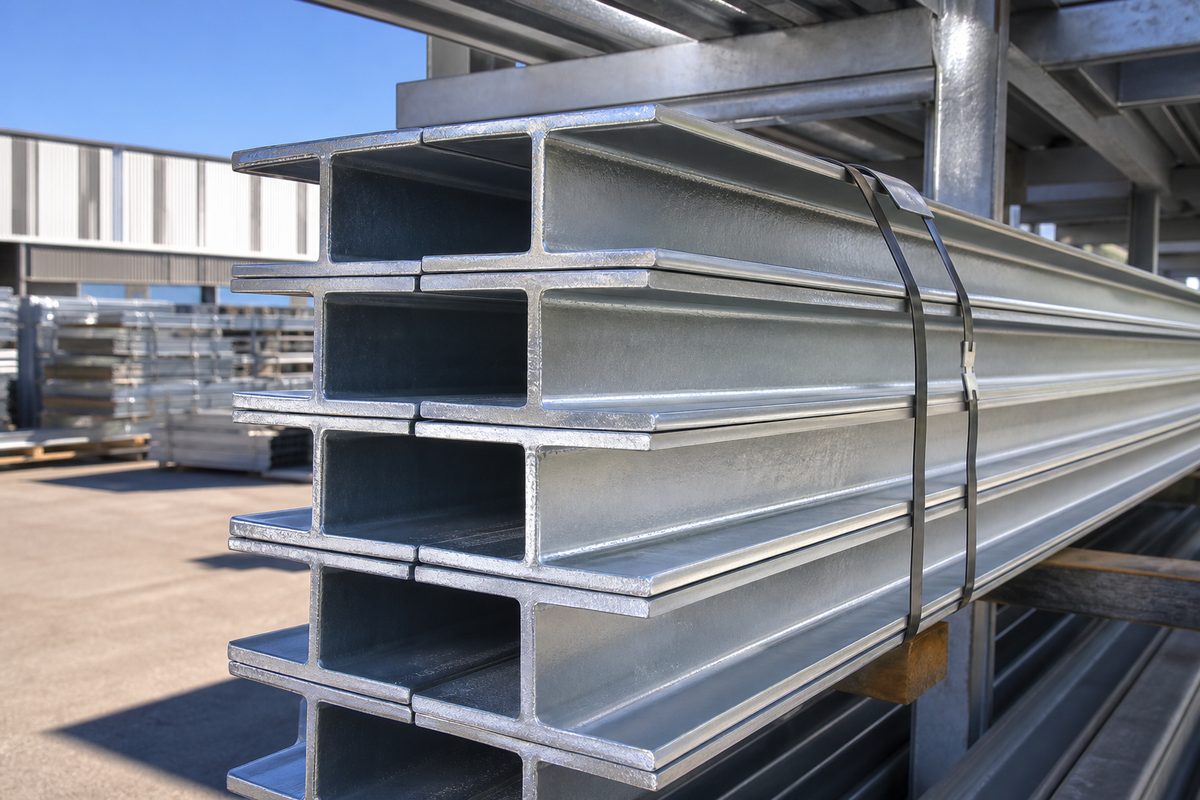
An H section has two flanges connected by a central web. Turn it upright and the gap between the flanges becomes a channel that sleepers slide into — no brackets, no bolts, no welding on site. Structurally, the flanges sit far apart from the neutral axis, which is where bending strength comes from. That gives you a post that resists soil pressure efficiently while doubling as the sleeper guide. Our full retaining wall steel range is built around these profiles.
The three profiles sold as “H section”
- Universal columns (UC) — wide, thick flanges, roughly square proportions. 100UC15, 150UC23.4, 200UC46.2 and 250UC72.9 are the common retaining wall sizes and the strongest option per metre of depth.
- Universal beams (UB) — deeper than they are wide, with narrower flanges. 150UB14, 200UB18 and 250UB25 give good bending strength economically, but the narrower flange means a shallower sleeper slot.
- Parallel flange channels (PFC) — a C shape used for end posts and corners where a sleeper only needs to enter from one side.
If a quote just says “H post”, ask for the designation. A 150UB14 and a 150UC23.4 look similar on a delivery docket and differ substantially in capacity. Our comparison of UC versus UB sections sets the two side by side.
What galvanised actually means
Hot-dip galvanising to AS/NZS 4680 immerses the finished post in molten zinc, forming a metallurgically bonded coating inside and out — including the inside faces of the flange slot, where paint never survives. For posts in soil, look for a coating thickness in the 85–100 micron range. Two things to avoid: pre-galvanised or painted sections sold as an equivalent (they corrode from the cut ends), and site cutting after galvanising. Order posts cut to length and drilled before they go in the zinc bath.
Choosing a size
Post size follows retained height, post spacing and surcharge. A very broad guide for standard 1.5 m centres in reasonable soil:
- Up to about 0.6 m retained: 100UC15 or 150UB14
- 0.6–1.2 m: 150UC23.4 or 200UB18
- 1.2–1.8 m: 200UC46.2 or 250UB25
- Above 1.8 m, or any wall with vehicle surcharge: 200UC59.5 to 250UC, engineer-designed
Treat that as a starting point for conversation, not a design. Anything over one metre, on a boundary, or supporting a structure needs engineering. See our specifications guide for how embedment and footing sizes scale with post size.
Installation basics that matter more than the post
Most failures we are called out to look at are not undersized steel. They are drainage and footings. Set posts plumb in concrete footings sized by the engineer, keep the flange slots aligned on a string line, and build the drainage properly: ag drain wrapped in geofabric at the base, free-draining aggregate behind the sleepers, and an outlet that actually discharges. Backfill in layers and compact lightly — heavy compaction plant close to the wall can overload posts before the wall is even finished.
Sleepers, caps and accessories
Galvanised H posts pair with concrete or timber sleepers; the sleeper range covers standard and premium thicknesses. Post caps, sleeper packers and fixings are in accessories, and finished walls using each profile are shown in the project gallery.
Order galvanised H section posts
We cut, drill and hot-dip galvanise H section retaining wall posts for jobs across Melbourne, Geelong and Gippsland, including Traralgon and the Latrobe Valley. Send your heights and lengths through the quote and order form, or get in touch if you want a hand reading the engineer’s schedule.